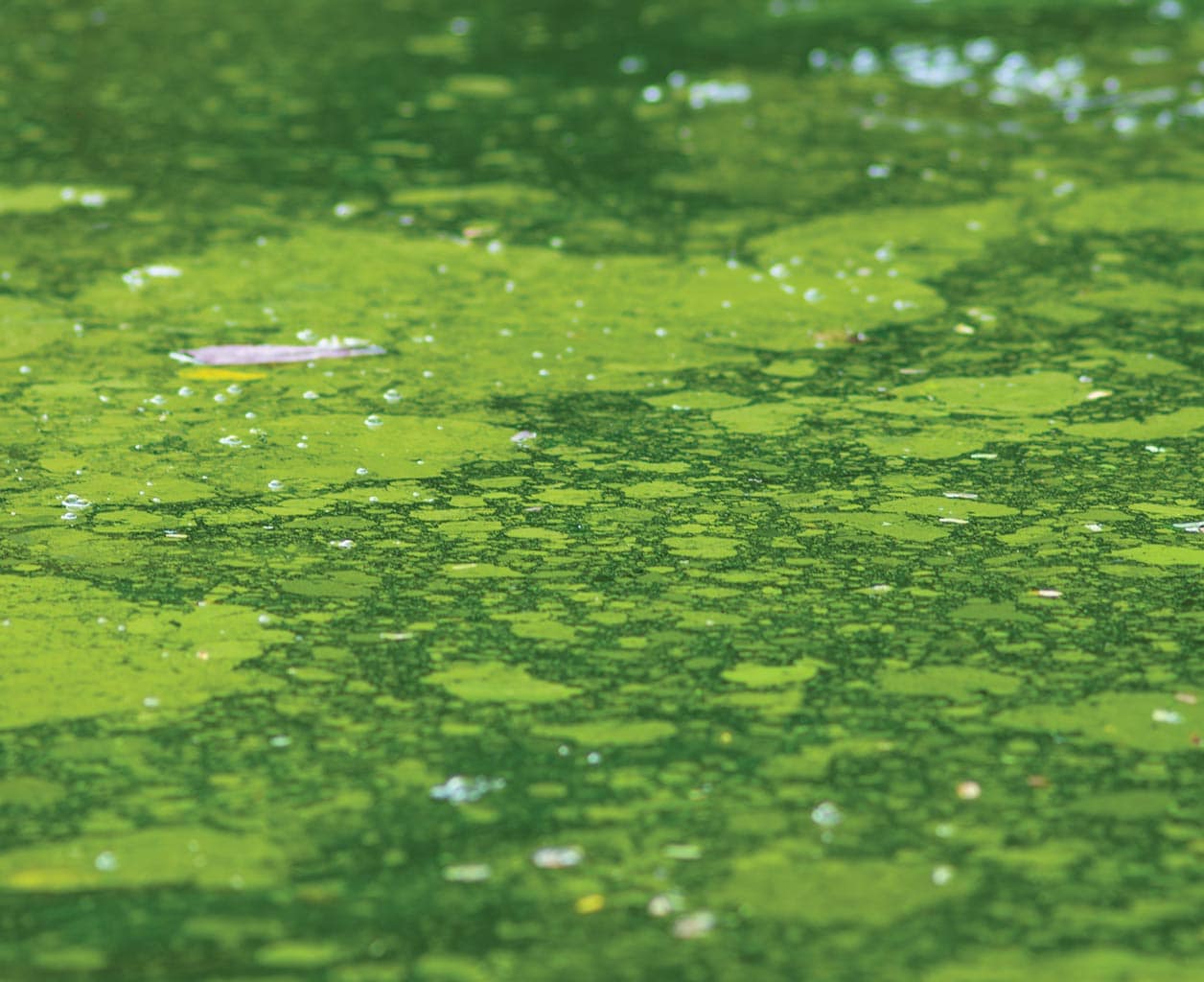
Picture a calm summer morning in the Fox River Valley or along Lake Geneva. The sun rises over still water, but instead of a clear reflection, the surface has transformed into a thick, pea-soup green. What was once a pristine lake now looks stagnant, opaque, and lifeless.
This isn’t just an aesthetic issue. It’s a chemical imbalance known as eutrophication—a process driven by excess nutrients that fuels explosive algae growth. Beyond the visual impact, eutrophication threatens property values, recreational use, and public health.
In this guide, McCloud Aquatics will walk you through identifying nutrient sources, understanding the risks of harmful algal blooms, and implementing proven remediation solutions tailored for Midwest waterbodies. The result is not just cleaner water, but a healthier, more resilient ecosystem and a stronger long-term investment in your property.
Is Nutrient Runoff Affecting Your Waterbody?
In the Midwest, the scale of the problem is significant. Illinois alone contributes substantial nutrient runoff, exporting approximately 82% of its nitrogen and 48% of its phosphorus downstream.
Combined with urban stormwater systems from the Chicago metro area, these inputs overload lakes and ponds with nutrients.
To understand why this happens, we must look at limiting nutrients. In freshwater ecosystems, phosphorus is typically the primary driver of algae growth. Even concentrations as low as $0.030 mg/L are enough to trigger nuisance blooms.
Once this threshold is exceeded, lakes can rapidly shift from balanced ecosystems to algae-dominated systems.
Understanding the sources and mechanisms behind this imbalance is the first step toward effective remediation.
Identifying the Sources: Why Your Lake is “Over-Fertilized”
Excess nutrients enter lakes through a mix of non-point sources like agricultural runoff and lawn fertilizers, and point sources such as wastewater discharge, while legacy phosphorus stored in sediments continues fueling blooms long after inputs decline.
Agricultural Runoff vs. Urban Stormwater
 Non-point sources, such as farm fields, golf courses, and residential lawns, are difficult to control. Rainfall washes fertilizers rich in nitrogen and phosphorus into nearby waterways. Urban stormwater systems compound this issue by rapidly channeling nutrient-laden runoff from impervious surfaces into lakes.
Point sources, like wastewater treatment plants, are easier to monitor but still contribute significant nutrient loads when not properly managed.
A critical but often overlooked factor is legacy phosphorus. Over decades, nutrients accumulate in bottom sediments, forming what is essentially a “nutrient battery.” Even if external inputs are reduced, this stored phosphorus can be released back into the water column under low-oxygen conditions, perpetuating algae blooms.
Additionally, emerging research from the USGS highlights the role of winter road salt. Elevated chloride levels can disrupt aquatic food webs by killing zooplankton, the natural grazers of algae, thereby indirectly promoting harmful algal blooms (HABs).
The Cyanotoxin Crisis: Understanding Harmful Algal Blooms (HABs)
Monitoring efforts across Northern Illinois in 2024 – 2025 have intensified, particularly at high-risk sites such as Gages Lake, Lake Barrington, and Loch Lomond. These waterbodies are increasingly vulnerable to harmful algal blooms.
The danger lies not just in the algae themselves, but in the toxins they produce.
- Microcystins: Potent liver toxins that can cause serious illness in humans and animals.
- Anatoxin-a: A fast-acting neurotoxin that can be lethal to pets and livestock within minutes of exposure.
These toxins can become aerosolized through wave action or recreational activity, posing inhalation risks. Contact exposure during swimming or accidental ingestion can also lead to severe health consequences.
Doing nothing is not a viable option. HABs represent an escalating public health concern that requires proactive management.
Chemical Sequestration: Choosing the Right Nutrient Binder
Modern nutrient-binding technologies offer targeted, effective ways to remove phosphorus from the water column and sediments, forming the backbone of many remediation strategies.
Alum, Phoslock, and the EutroSORB Revolution
Three primary phosphorus-binding solutions dominate the market:
1. Alum (Aluminum Sulfate)
The traditional workhorse, alum forms a “floc” that settles to the bottom, binding phosphorus and creating a cap over sediments. It can remain effective for 8 – 20 years but requires careful pH management to avoid ecological stress.
2. Phoslock
This lanthanum-modified clay permanently binds phosphorus, even under low-oxygen (anoxic) conditions. It is particularly useful in lakes where internal loading is persistent.
3. EutroSORB WC
A next-generation mineral binder, EutroSORB WC, achieves comparable or superior phosphorus removal using significantly lower application volumes—typically 10 – 15 PDU per pound of phosphorus. It also has a negligible impact on overall water chemistry, making it an environmentally refined solution.
Bio-Dredging: Digesting the “Nutrient Battery”
Mechanical dredging is costly and disruptive. McCloud Aquatics offers a more sustainable alternative: bio-dredging.
This approach uses beneficial bacteria and probiotics, such as Muck Remover pellets, to naturally break down organic sediment. Acting like biological lawnmowers, these microbes digest accumulated muck at rates of up to 6 inches per season.
As they work, they convert foul-smelling compounds (like hydrogen sulfide, responsible for “rotten egg” odors) into harmless gases. The result is a cleaner, more compact lakebed without the need for heavy equipment or habitat disruption.
The Oxygen Revolution: Nanobubbles and OST
Oxygen is a critical factor in controlling nutrient release and maintaining aquatic health. Traditional aeration systems, like fountains, offer limited efficiency. New technologies are redefining what’s possible.
Nanobubbles
These microscopic bubbles (100 – 200 nm) remain suspended in the water column for 2 – 3 months, dramatically increasing oxygen transfer efficiency to 30 – 100%. In contrast, conventional bubblers achieve only 6 – 10% efficiency due to rapid surface escape.
Oxygen Saturation Technology (OST)
OST systems directly target the anoxic zone at the sediment-water interface. By delivering 5 – 10 times more oxygen than traditional aeration, OST prevents phosphorus release from sediments, effectively locking nutrients in place and disrupting the eutrophication cycle.
Navigating the Regulatory Landscape
Lake management in the Midwest must align with state-specific environmental regulations.
Wisconsin (NR 102 Standards)
Phosphorus limits typically range from 15 – 40 µg/L, depending on lake type and ecological classification. These numeric criteria are strictly enforced to protect water quality.
Illinois (Nutrient Loss Reduction Strategy – NLRS)
Illinois focuses on reducing nutrient export through a “Dissolved Oxygen Signature” approach, with a statewide goal of cutting phosphorus loading by 45% by 2040.
Permitting Requirements
Any chemical application in public waters requires approval and must be conducted by licensed professionals. Compliance ensures both environmental protection and legal adherence.
The Financial Case: ROI of Water Clarity
Investing in lake health isn’t just environmentally responsible—it’s economically strategic.
Regional studies show that improving water clarity by just 3 feet can increase home values by $8,000 to $32,000. For homeowner associations and municipalities, this represents a measurable return on investment.
In regions like Vilas County, Wisconsin, where waterfront properties dominate, property taxes account for approximately 75% of local revenue. Healthy lakes are a beautiful amenity for your property as well as a foundation of the local economy.
Restoring the Balance
Effective nutrient remediation is not about fighting nature; it’s about working with it.
Integrated strategies that combine chemical binders, biological digestion, and advanced oxygenation create a balanced, self-sustaining ecosystem. These “Friends of the Water” approaches stabilize nutrient cycles, improve clarity, and restore ecological integrity over the long term.
Take Action Today
Contact McCloud Aquatics today for a professional nutrient assessment!
Don’t wait for the next bloom to take action; protect your investment and our water resources for generations to come.